Design for visually impaired people is increasingly moving beyond traditional assistive devices toward products that combine accessibility, independence, and everyday usability. From wearable technology that can anticipate obstacles to simple tools that make Braille easier to correct and produce, designers are finding new ways to address challenges that are often invisible to sighted users. These innovations demonstrate how thoughtful design can translate complex technology into intuitive experiences, while also showing that accessibility does not always require complexity.
Biped.ai by Mael Fabien
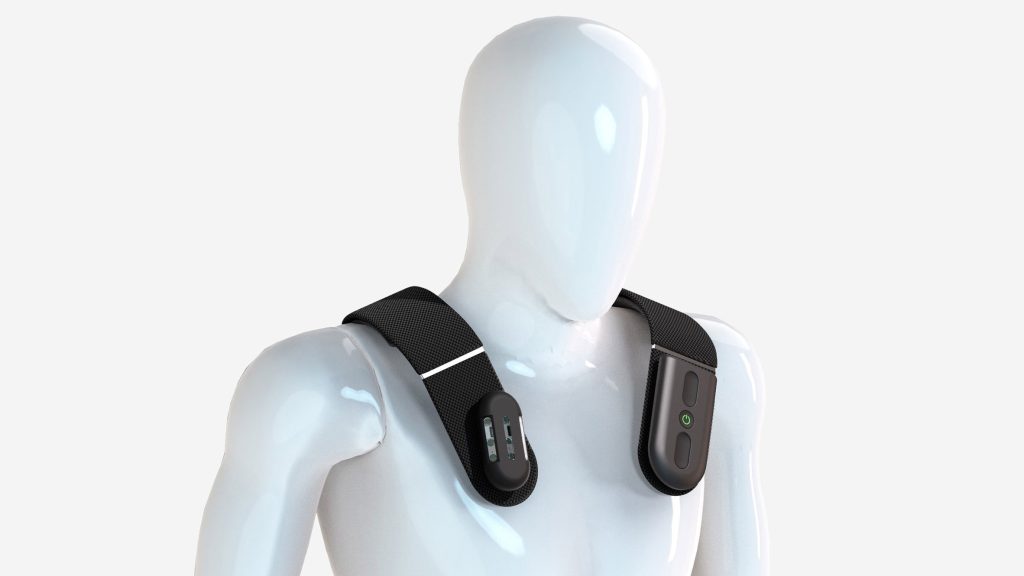
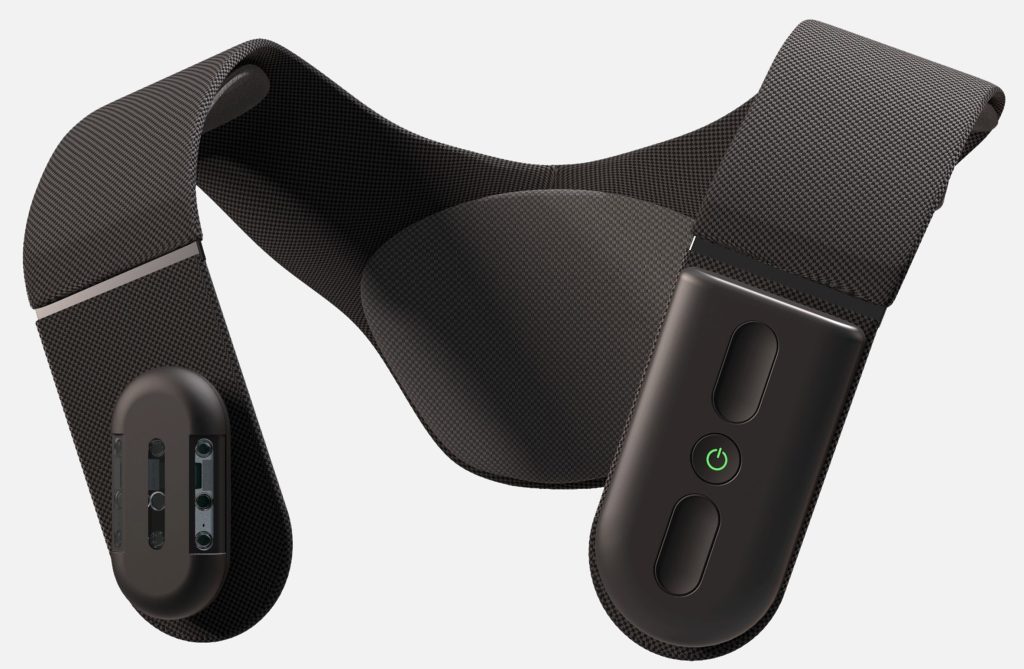
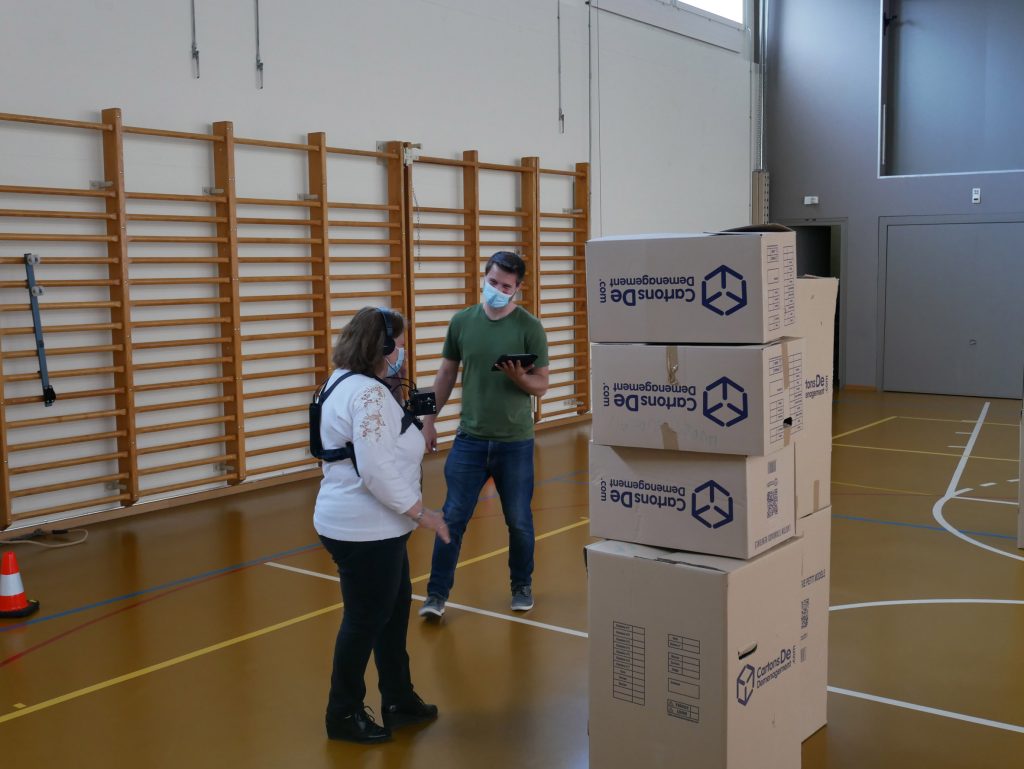
Swiss startup Biped has adapted a technology more commonly associated with autonomous vehicles for an entirely different purpose: helping blind and visually impaired people navigate their surroundings. Introduced at CES, the Biped.ai is a minimalist shoulder harness equipped with 3D cameras that detect obstacles and anticipate their movement. Rather than relying solely on physical contact with the environment, the system gives users advance information about what is happening around them.
Biped.ai by Mael Fabien
At the heart of the device is software called Copilot, which draws on principles developed for autonomous driving. Its cameras monitor a 170-degree field of view, tracking surrounding objects and predicting their trajectories several seconds ahead. The system can recognize more than 10 types of objects and prioritizes those that present a potential collision risk. A bicycle approaching from 12 metres away, for example, can trigger a warning, while an irrelevant nearby object can be filtered out.
Biped.ai by Mael Fabien
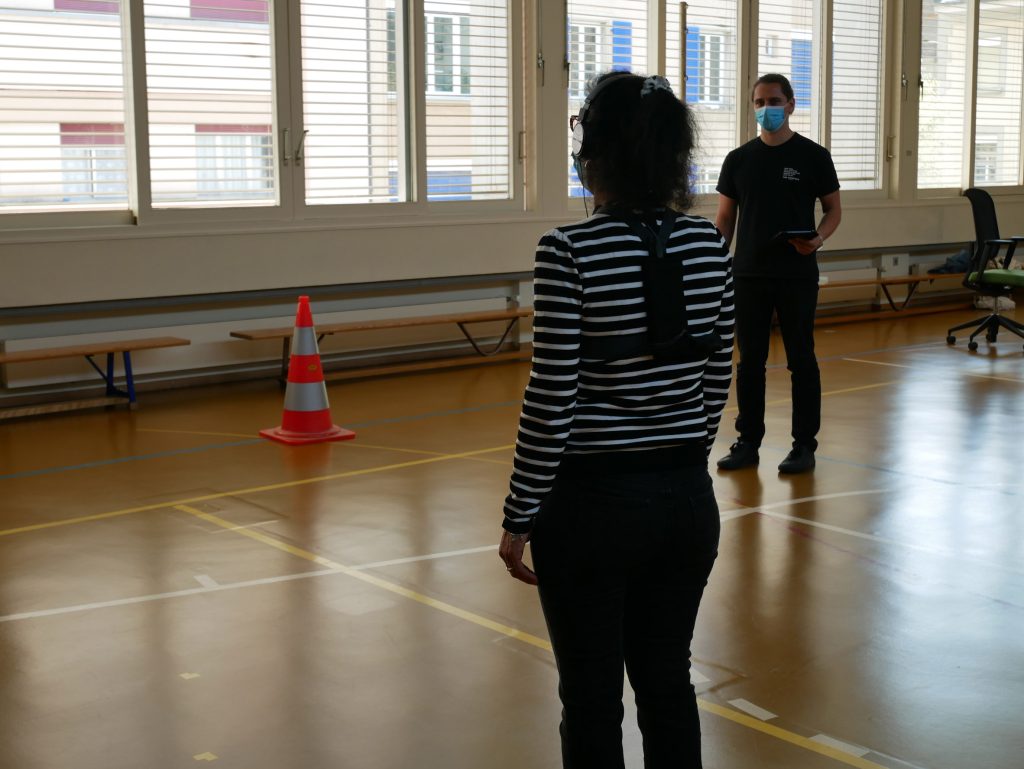
The information is communicated through spatial audio, creating directional sounds that help users understand where an obstacle is located. Biped.ai can also connect to a smartphone’s GPS and provide navigation instructions through audio cues. Infrared cameras allow the system to operate in darkness, while a removable battery provides more than six hours of use. The result is a product that translates a sophisticated sensing system into an interaction that feels relatively simple: hear where the problem is, anticipate it, and adjust your path.
Biped.ai by Mael Fabien
The idea originated from cofounder Mael Fabien’s experience working at an ophthalmic hospital in Lausanne, where he observed that patients were looking for alternatives or complements to traditional mobility aids such as canes and guide dogs. Developed with Bruno Vollmer during a Swiss hackathon, Biped.ai illustrates an important principle of inclusive design: advanced technology becomes most valuable when it disappears behind an intuitive experience.
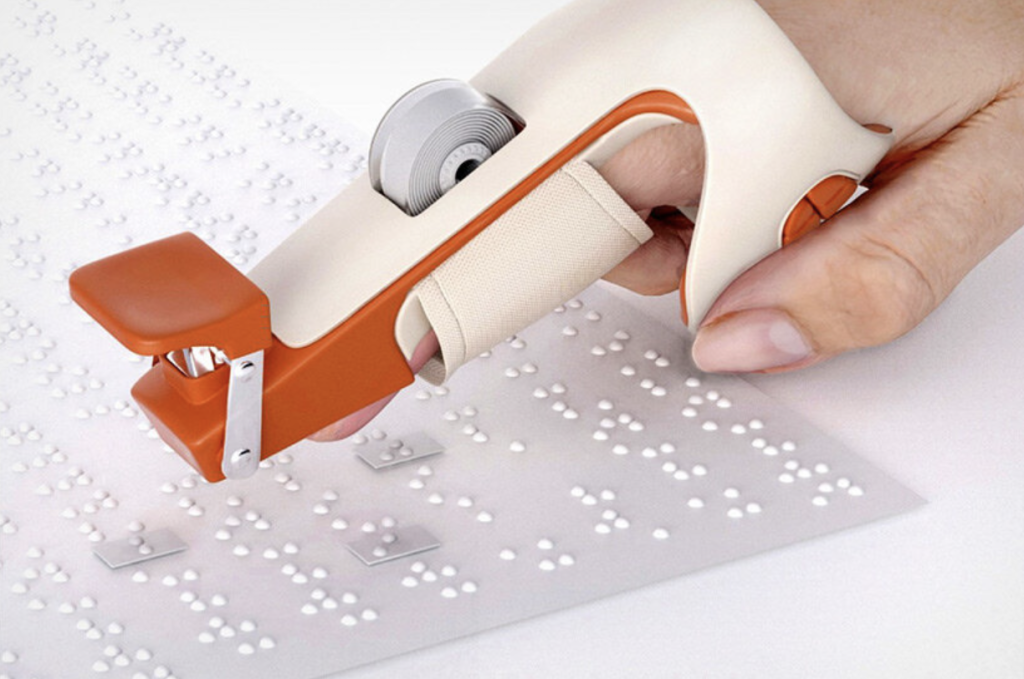
Braille Correction Device by Tian-Yi Chen, Chao-Jie Hu, Yi-Xuan Li and Xue-Nan Zheng
If Biped.ai demonstrates how sophisticated technology can support mobility, the Braille Correction Device takes almost the opposite approach. Designed by Tian-Yi Chen, Chao-Jie Hu, Yi-Xuan Li and Xue-Nan Zheng at Zhejiang University of Technology, the product is a simple hand-worn tape dispenser designed to correct mistakes in Braille. It addresses a deceptively practical problem: fixing an error in embossed text can be considerably more difficult than correcting a typo on a conventional printed page.
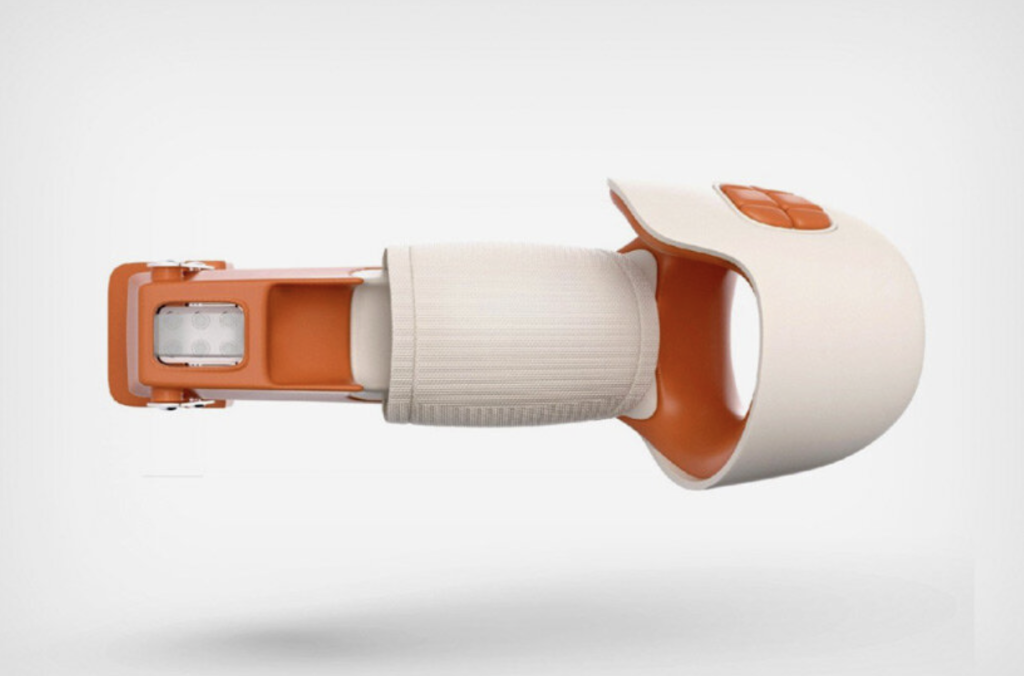
Braille Correction Device by Tian-Yi Chen, Chao-Jie Hu, Yi-Xuan Li and Xue-Nan Zheng
Braille publishing is relatively complex, and mistakes can be difficult to edit without damaging the underlying paper. The designers responded with an intentionally straightforward solution. The device uses tape of a specific thickness to cover an incorrect Braille character or word, allowing a corrected version to be placed over it. Because Braille follows a monospaced structure, the replacement can align with the existing text without requiring an elaborate editing process.
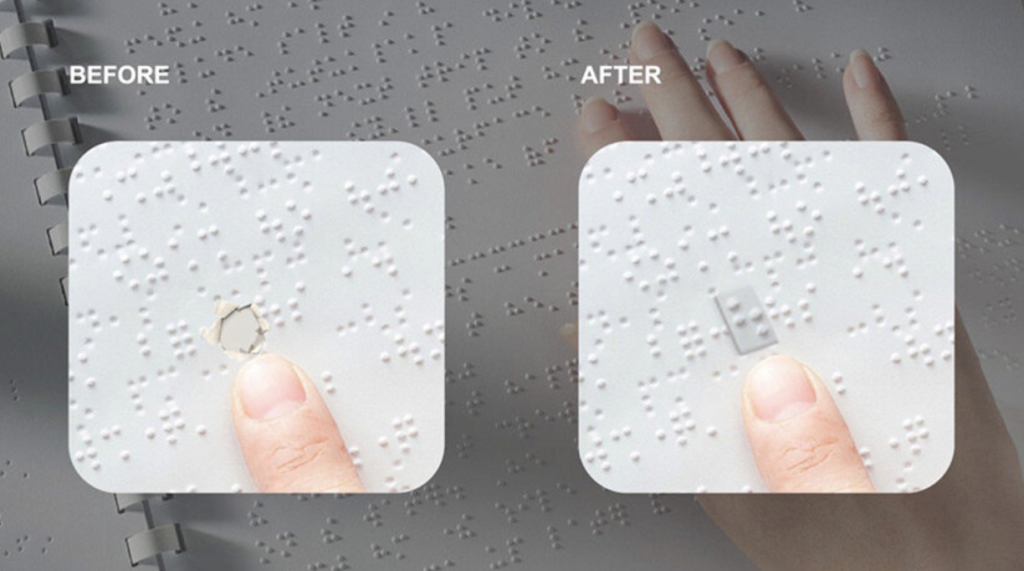
Braille Correction Device by Tian-Yi Chen, Chao-Jie Hu, Yi-Xuan Li and Xue-Nan Zheng
Its operation is deliberately tactile. After identifying an error, the user presses a button on the side to load the tape and then activates a front button to dispense it. The correction effectively works like a miniature piece of correction tape adapted to the physical language of Braille. There are no complex electronics or interfaces to learn, which is precisely what makes the concept compelling.
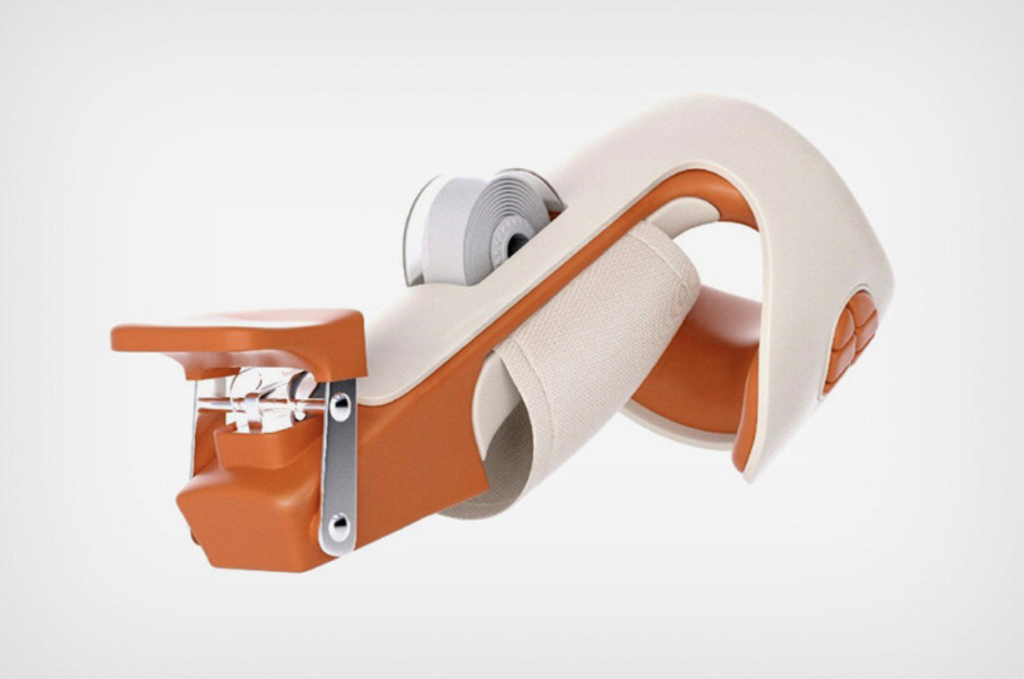
Braille Correction Device by Tian-Yi Chen, Chao-Jie Hu, Yi-Xuan Li and Xue-Nan Zheng
Recognized with a Golden Pin Design Award in the Product Design category, the device demonstrates that innovation does not necessarily mean adding more technology. Sometimes it means noticing a neglected friction point and removing it with the simplest possible intervention. In this case, a modest piece of tape becomes a tool for making Braille production and editing more practical.
Nemonic Dot by Mangoslab (also header image)
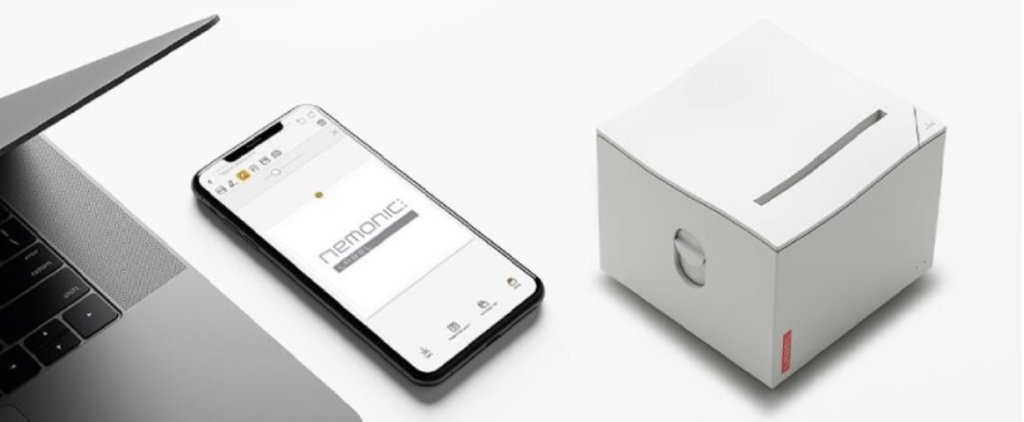
The third concept moves from correcting Braille to creating it. Nemonic Dot, developed by Mangoslab, combines a mobile app with a compact Braille printer that converts typed or spoken words into tactile stickers and labels. The system is designed to make Braille labeling easier in everyday environments, without requiring users to manually translate or format the text themselves.
Nemonic Dot by Mangoslab
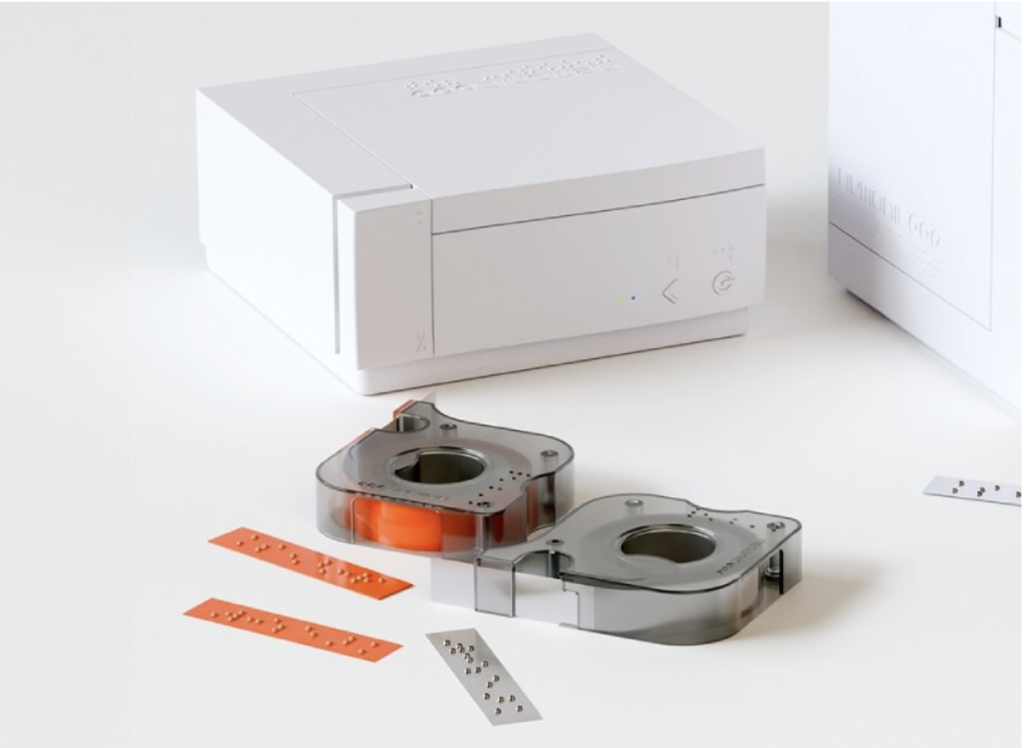
The mobile app provides both text and voice input, while contextual keyword suggestions can help users formulate clearer labels and reduce errors. Once the content is prepared, the accompanying printer produces Braille using a proprietary pressing mechanism. The raised dots are approximately 0.6 millimetres high and follow international Braille standards, with consistent spacing and height intended to make the labels comfortable to read by touch.
Nemonic Dot by Mangoslab
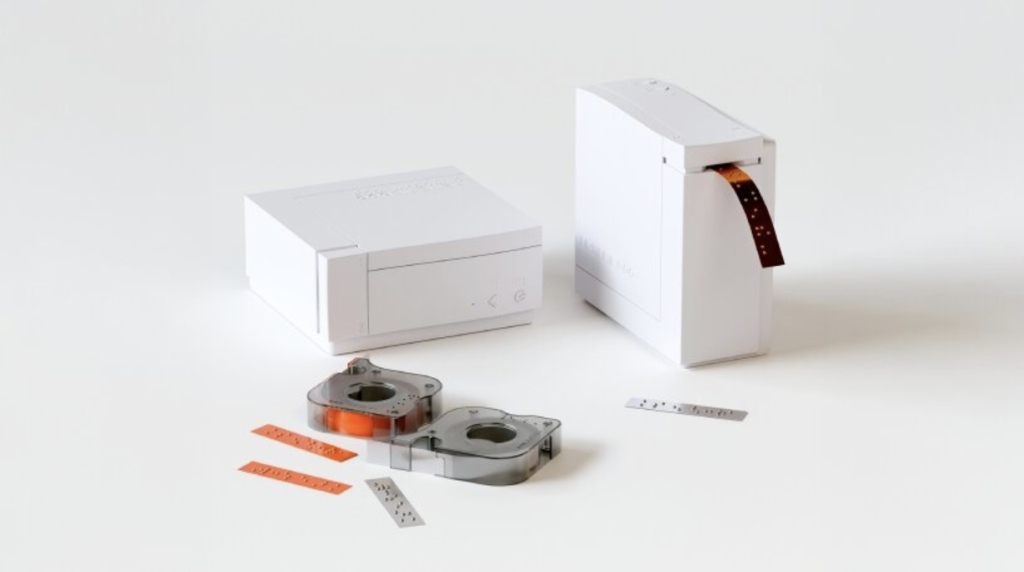
The printer itself is designed around an eyes-free interaction model. Its tactile textures help users identify different parts of the device, while tasks such as loading cartridges, aligning materials and activating the printer can be performed through touch. Battery power and Bluetooth connectivity further reduce the need for a fixed workstation, turning the machine into a portable tool rather than another piece of equipment that requires assistance to operate.
Nemonic Dot by Mangoslab
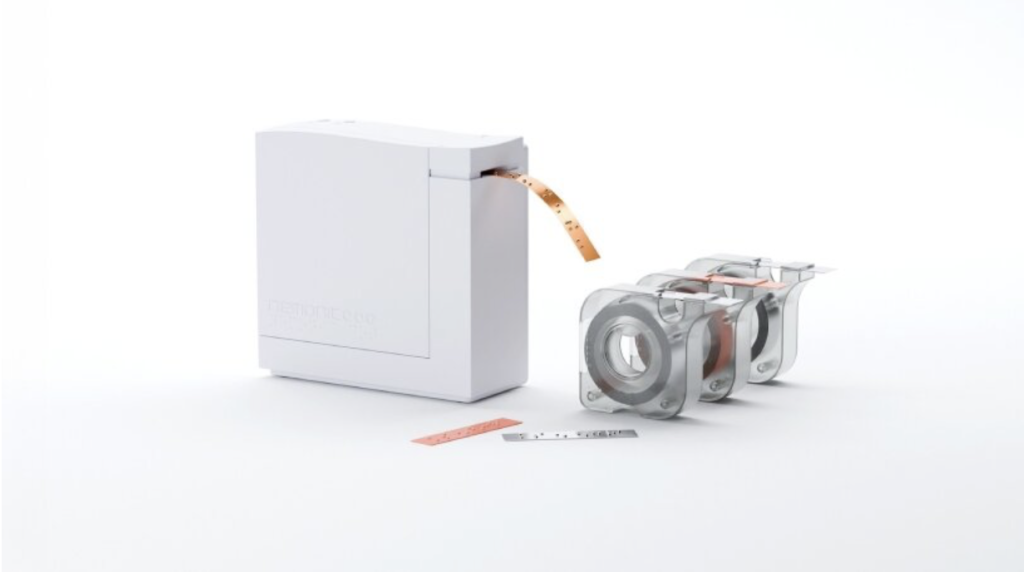
That portability opens up a wide range of everyday applications. Users could create labels for food and medication, identify documents, organize household objects or mark personal belongings. Presented at CES 2026 in Las Vegas, Nemonic Dot shows how accessibility can move beyond specialized environments and into ordinary routines. Its combination of digital input and physical output also points toward a broader design opportunity: using technology to translate information into forms that suit different ways of perceiving the world.
What connects these products is not simply their use of technology, but their attention to independence. Each one starts with a task that can be difficult for someone who cannot rely on sight and redesigns the experience around other forms of interaction, including touch, sound, and voice. In doing so, they illustrate an important direction for contemporary design: accessibility is not an added feature, but an opportunity to rethink how products communicate with and respond to their users. For visually impaired people, the most meaningful innovation may ultimately be design that makes everyday actions feel more intuitive, confident, and independent.